
Table of Contents
Custom Iron Security Doors in New Orleans, LA
Your home or business is worth protecting, and Big Easy Iron Works has been crafting and installing custom iron security doors in New Orleans for over 30 years. From Uptown shotguns to French Quarter storefronts, we build doors that stop forced entry, survive Gulf Coast weather, and satisfy HDLC design standards for historic properties. Call us today at 504-732-0066 for a free estimate.
New Orleans presents a unique combination of challenges that most security door companies outside Louisiana simply do not understand: hurricane-force wind loads, year-round humidity and salt air corrosion, strict Historic District Landmarks Commission (HDLC) design rules, and property crime rates that consistently rank among the highest in the nation. A standard big-box security door is not engineered for any of these realities. A custom wrought iron or hollow metal door from Big Easy Iron Works is.
Whether you need a single ornamental iron screen door for a Garden District Victorian, a hollow metal commercial door for a Warehouse District office, or a full double-door entry with multi-point locks for a Lakeview home, our team designs, fabricates, and installs every door to fit your exact opening, match your architecture, and meet the security level your property requires.

Types of Security Doors We Install in New Orleans
Not every security door is the same, and the right type depends on your property’s construction, your security goals, and any historic district requirements. Big Easy Iron Works installs all major security door types for both residential and commercial customers throughout the New Orleans metro area.
Wrought Iron Security Doors
Wrought iron is the signature material of New Orleans architecture, and it is also one of the most effective security door materials available. Iron doors are heavy, rigid, and extremely difficult to kick, pry, or cut through. Our wrought iron security doors are hand-fabricated in our shop, allowing us to match historic scroll patterns, fleur-de-lis motifs, and other period-correct details while delivering a core that is engineered for forced-entry resistance. Iron is ideal for visible entry points where you want both security and curb appeal.
Steel Core Security Doors
A steel core door uses a solid steel slab or steel-reinforced frame bonded inside a wood or steel skin. These doors offer exceptional resistance to kick-in attacks and crowbar prying because the steel core distributes force across the entire panel rather than concentrating it at the lock. Steel core doors are popular for rear entries, side gates, and high-risk residential applications where appearance is secondary to raw stopping power. We source commercial-grade steel core units and reinforce them with our own frame anchoring systems for installations that meet or exceed the Louisiana Uniform Construction Code requirements.
Hollow Metal Security Doors
Hollow metal doors (also called HM doors) are the standard for commercial and institutional security across Louisiana. Built to HMMA (Hollow Metal Manufacturers Association) standards, these doors feature a cold-rolled steel face sheet over a steel or polyurethane core with welded steel edges. They are impact-resistant, fire-rated in many configurations, and capable of accepting a full range of commercial hardware including panic bars, electric strikes, and access control systems. If your New Orleans business, clinic, school, or multi-family property needs a door that will take years of daily traffic and still resist a forced-entry attempt, hollow metal is the answer.
Double Security Doors
Double security doors, also called French security doors, use two active panels that meet at the center with a heavy-duty astragal bolt system. They are common in New Orleans where wide historic openings cannot accommodate a single oversized panel. Both panels can be secured independently, and multi-point locking can be applied to each leaf. Double iron security doors are especially popular in the Garden District, Uptown, and Mid-City neighborhoods where original door openings are 6 feet wide or wider.
Security Screen Doors (Combination Doors)
A security screen door mounts in front of your primary door, providing ventilation, light, and an additional barrier against forced entry without blocking airflow. In New Orleans’ subtropical climate, these are extremely popular: you can keep your main door open for the breeze while the iron security screen keeps out intruders. Our security screen doors use expanded steel or close-spaced bar grilles that cannot be cut with standard tools, combined with heavy-duty hinges and a Grade 1 deadbolt.

Iron Security Doors for New Orleans Homes: Why Iron Is the Right Choice
New Orleans homeowners face a specific set of conditions that make wrought iron the ideal security door material. Understanding those conditions helps explain why iron outperforms aluminum, fiberglass, and standard steel alternatives in this climate.
New Orleans Crime Context
NOPD crime data shows New Orleans continues to have property crime rates significantly above national averages. While the city recorded meaningful violent crime reductions in the first quarter of 2026, burglary and theft remain frequent, particularly in transitional neighborhoods and during late-night hours. National FBI data consistently shows that roughly one in three residential burglaries begins with the front door, typically a kick-in attack that defeats a standard door in under 10 seconds. A properly installed iron security door eliminates this vulnerability entirely. Iron door frames anchored 6 inches or deeper into masonry cannot be kicked free; iron grilles cannot be bent by hand; and the weight of an iron door (often 150 to 300 pounds) prevents the prying and lifting attacks that defeat lighter materials.
Gulf Coast Humidity and Salt Air
New Orleans sits at sea level in a subtropical zone, with average annual relative humidity above 75 percent and salt-laden air pushing in from Lake Pontchartrain and the Gulf. Standard steel doors without proper coating will begin to surface rust within months in this environment. Our iron and steel security doors are cleaned, primed with a rust-inhibiting primer, and finished with a powder coat or oil-based enamel rated for coastal environments. We also apply a weatherproofing sealant to all welded joints and hardware mounting points. With proper annual maintenance, a Big Easy Iron Works security door will remain rust-free and structurally sound for 30 or more years in the New Orleans climate.
Architectural Compatibility
New Orleans architecture is unlike any other American city. Shotgun houses, Creole cottages, double galleries, and Italianate townhouses all have door openings, proportions, and design vocabularies that a stock security door cannot match. Our custom fabrication process starts with a field measurement of your exact rough opening, then our design team creates a door profile that fits the scale and style of your home. We can replicate historic ironwork patterns found elsewhere on your property, match the pitch of your fanlight or sidelight, and integrate your existing entry hardware if it is in good condition.
Security Doors for Historic and HDLC Properties
Approximately 55,000 buildings in New Orleans fall within one of the city’s historic or conservation districts, and any exterior alteration, including door replacement, requires review and approval from either the Historic District Landmarks Commission (HDLC) or the Vieux Carre Commission (VCC) before work begins. This requirement catches many homeowners by surprise and can turn a straightforward door installation into a months-long permit battle if the wrong contractor is involved.
What Is the HDLC?
The Historic District Landmarks Commission is the City of New Orleans agency responsible for reviewing exterior alterations to buildings within local historic districts, including Esplanade Ridge, Faubourg Marigny, Tremé, Gentilly Terrace, the Garden District, and many others. The HDLC reviews proposed changes for compatibility with the historic character of the district and has the authority to deny permits for alterations it considers incompatible. For doors specifically, the HDLC guidelines emphasize using materials and profiles that are consistent with the age and style of the building. Iron and steel are almost universally accepted because they have been part of New Orleans’ architectural fabric since the early 1800s.
What Is the VCC?
The Vieux Carre Commission oversees the French Quarter, one of the most strictly regulated historic districts in the United States. The VCC reviews virtually all exterior changes to buildings within the French Quarter, including door replacements, gate installations, and railing modifications. Iron work is traditional in the Quarter and is generally viewed favorably by the VCC, but the specific design, dimensions, and finish must be documented and submitted for review. Working with a fabricator who has experience with VCC submissions significantly speeds the approval process.
How Big Easy Iron Works Handles HDLC and VCC Projects
We have designed and installed iron security doors for properties in the French Quarter, Garden District, Faubourg Marigny, Tremé, and other controlled districts throughout our 30-plus year history in New Orleans. Our team is familiar with the design guidelines that govern each district and can prepare documentation, drawings, and material samples to support your permit application. We do not guarantee permit approval, which rests with the commission, but we design every historic district project with commission compatibility as a primary requirement from the first site visit.
Key Design Principles for Historic District Compliance
- Profile matching: New security doors should replicate or complement existing ironwork profiles on the building, including rail height, bar spacing, and decorative motifs
- Material appropriateness: Wrought iron and steel are appropriate for pre-1940 construction; aluminum and vinyl generally are not accepted in full-control districts
- Reversibility: HDLC favors installations that do not permanently damage original fabric; we use anchor systems that minimize masonry alteration
- Scale and proportion: Door height, width, and visual weight must be proportional to the opening and the facade as a whole
- Glass use: Where security glass or tempered glass panels are incorporated, the lite pattern and muntin profile must be compatible with the building’s historic window and door character
Hurricane-Rated Security Doors for Louisiana Homes and Businesses
Louisiana’s coastal location puts most of the New Orleans metro within a High Velocity Hurricane Zone (HVHZ) or equivalent wind zone requiring products tested to withstand hurricane-force winds and wind-driven debris. Standard security doors, even heavy iron ones, are not automatically hurricane-rated. A door must be tested and certified under specific protocols to qualify as impact-resistant for insurance and code purposes.
Florida Product Approval and Louisiana Use
Louisiana commonly recognizes Florida Product Approval (FPA) certifications for hurricane-impact products, including impact-rated doors, because Florida’s testing protocols are among the most rigorous in the nation. An FPA-certified iron door has been tested to the Miami-Dade County Large Missile Impact Test (TAS 201) and Cyclic Pressure Test (TAS 203), which simulate the conditions of a major hurricane including airborne debris traveling at high speed. When we source or fabricate hurricane-rated security doors for New Orleans properties, we can provide documentation of the applicable FPA or NOA (Notice of Acceptance) certification for your permit and insurance files.
Wind Load Requirements in New Orleans
The Louisiana Uniform Construction Code incorporates ASCE 7 wind load standards. For New Orleans and the surrounding parishes, design wind speeds typically range from 130 to 150 mph for residential construction in Risk Category II. Any door system installed in an exterior wall must be capable of resisting both positive (inward) and negative (outward/suction) pressure at these wind speeds. Our installation team accounts for wind load requirements in the frame anchorage design for every exterior security door, using approved hardware and anchor spacing to meet or exceed the code requirement for your specific address and building type.
Impact Glass Options
Where your security door design incorporates glass, we recommend laminated impact glass rather than tempered glass alone. Laminated impact glass uses a polyvinyl butyral (PVB) interlayer bonded between two glass panes. When struck by debris, the glass may crack but the fragments remain adhered to the interlayer, preventing penetration and maintaining the door’s weather seal. This is the same glass technology used in hurricane-impact windows and is far superior to tempered glass (which shatters into small cubes) for both security and storm protection. Impact laminated glass also provides a meaningful reduction in forced-entry risk because it cannot be quickly cleared by an intruder, unlike standard tempered glass.
Grade 1 Locks and Multi-Point Locking Systems
The strongest door in the world is only as secure as its lock. Big Easy Iron Works specifies and installs ANSI/BHMA Grade 1 hardware on all security door installations as a baseline standard, and we recommend multi-point locking systems for primary entry doors on both residential and commercial properties.
What Is ANSI/BHMA Grade 1?
The American National Standards Institute (ANSI) and Builders Hardware Manufacturers Association (BHMA) publish grading standards for door hardware performance. Grade 1 is the highest performance classification. A Grade 1 deadbolt must withstand 10 blows of 75 foot-pounds of force applied to the bolt, survive 1 million operational cycles without failure, and meet stringent standards for latch retraction force, backset tolerances, and finish durability. Grade 1 mortise locks, which are the most common style on commercial and high-security residential installations, exceed these baselines with heavier case construction and more complex internal mechanisms. By contrast, the Grade 2 and Grade 3 hardware commonly found on standard residential doors at home improvement stores is rated for 250,000 to 400,000 cycles and is tested to withstand far less impact force.
Multi-Point Locking Systems
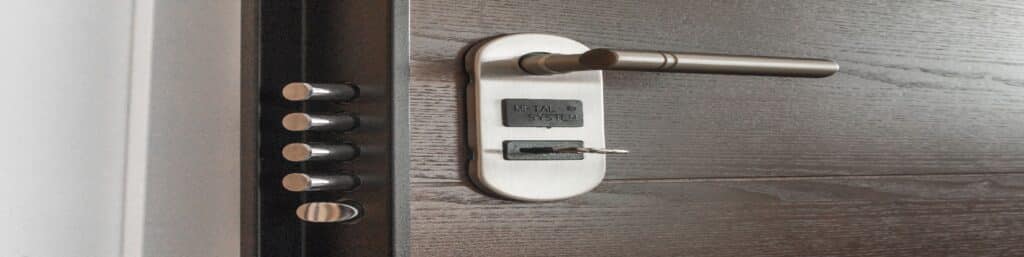
A standard single-point deadbolt secures the door at one location. A multi-point locking system (MPLS) engages at three, five, or more points simultaneously across the height of the door when the key or lever is turned. Typically, a MPLS secures at the strike (center), at a top bolt into the door head, and at a bottom bolt into the threshold or floor. Some systems add intermediate bolts at 24-inch intervals for very tall doors. The result is a door that is essentially clamped into its frame along its full height, making kick-in and prying attacks exponentially more difficult. Force applied at the lock now has to overcome resistance at multiple points rather than just one, which exceeds the capability of most forced-entry attempts without specialized tools and extended effort. Multi-point locking is standard on many European iron doors and is increasingly specified on American security installations in high-crime areas.
Smart Lock and Keypad Integration
We can integrate Grade 1-rated electronic deadbolts and smart lock hardware into our iron security doors for customers who want keyless entry, access logs, or remote monitoring. Smart locks in ANSI/BHMA Grade 1 configurations are available from several manufacturers and mount into standard prep bores on our iron door frames. We can also accommodate keypad entry for rental properties, Airbnb units in the French Quarter, and commercial spaces that require coded access for multiple users without key management overhead.
Security Door vs Storm Door: What Is the Difference?
These two terms are used interchangeably by many homeowners, but they describe very different products with different purposes. Understanding the distinction helps you choose the right door for your needs.
Storm Doors
A storm door is a lightweight secondary door installed in front of your main entry door, primarily to improve weathertightness and energy efficiency. Most storm doors are made from aluminum or light steel with large glass panels or screen inserts. They provide some wind and rain protection for the main door, improve insulation, and allow ventilation when the primary door is open. Standard storm doors offer minimal security benefit: they are lightweight, their hinges are typically surface-mounted with short screws, and their locks are simple latch mechanisms that can be defeated quickly. A storm door is a weather product, not a security product.
Security Doors
A security door is engineered specifically to resist forced entry. It is made from heavy-gauge steel or iron, has reinforced frame anchoring, uses Grade 1 or commercial-grade locks, and is designed to absorb and distribute the force of kick-in or prying attempts without deforming. A properly installed iron security door from Big Easy Iron Works weighs 150 to 400 pounds, is anchored 6 or more inches into masonry or structural framing, and uses five-pin lock cylinders that cannot be shimmed or picked with common tools.
Combination Doors
Some products marketed as “security storm doors” attempt to combine both functions by using a heavier frame, reinforced glass, and better locks than a standard storm door. These combination products occupy a middle ground: they are more secure than a standard storm door but generally less secure than a purpose-built iron security door. For New Orleans homeowners who want both ventilation and security, we recommend our iron security screen doors, which use heavy expanded-steel or close-spaced bar grilles instead of glass, providing unrestricted airflow with genuine forced-entry resistance. You can review our full storm door options on our New Orleans storm doors page.
Custom Ornamental Iron Security Doors: New Orleans Designs
Security and beauty are not mutually exclusive. New Orleans has proven this for nearly two centuries: the city’s iron galleries, gates, and doors are both functionally strong and visually stunning. Big Easy Iron Works custom fabricates ornamental iron security doors that incorporate the design vocabulary of New Orleans architecture while delivering the performance specifications of a modern security installation.
Fleur-de-Lis and Classic Motifs
The fleur-de-lis is the most iconic New Orleans decorative element, appearing on ironwork across every historic neighborhood. We incorporate fleur-de-lis scrollwork into security door panels, grille inserts, and top rail treatments as either the primary decorative element or as accent pieces within a larger pattern. Other classic New Orleans ironwork motifs we regularly fabricate include morning glory vines, anthemion (stylized honeysuckle), acanthus leaves, palmette fans, and simple interlocking geometric grilles appropriate for Creole-era buildings.
Scroll Work and Basket Designs
Scrollwork, in which iron bars are heated and bent into spiraling curves, is a hallmark of antebellum New Orleans ironwork. Our shop fabricates hand-scrolled panels using traditional techniques alongside modern CNC bending for consistent geometry. Basket weave designs, in which flat bars are interlocked in a woven pattern, are popular for lower door panels and provide excellent visual coverage (reducing sightlines into your home) while remaining fully compliant with HDLC guidelines for historic districts.
Powder Coat Colors and Finishes
Our security doors are finished in your choice of powder coat color from our standard palette or custom-matched to your existing ironwork, shutters, or trim color. Classic New Orleans ironwork finishes include flat black (most common), dark bronze, oil-rubbed dark green, and antique silver. We can also apply specialty finishes including hammered texture, antique patina, and two-tone combinations for decorative effect. All finishes are applied over a rust-inhibiting primer and cured to a durable, UV-stable surface that resists chipping and fading in the New Orleans sun.
Glass Panel Options
Many of our ornamental iron security doors incorporate glass panels for light transmission and visibility. Standard options include clear tempered glass, frosted or obscured tempered glass for privacy, decorative textured glass, and laminated impact glass for hurricane-rated applications. We can also integrate wrought iron grilles within glass panels for a traditional appearance while maintaining glass integrity. All glass panels in security door applications use full perimeter glazing stops secured with tamper-resistant fasteners to prevent glass removal from the exterior.
Commercial Security Doors in New Orleans
Big Easy Iron Works installs commercial-grade security doors for businesses, multi-family residential properties, schools, churches, and institutional facilities throughout Greater New Orleans. Commercial security door requirements differ significantly from residential in several ways.
ADA Compliance
Commercial doors must comply with the Americans with Disabilities Act (ADA) and its accessibility standards. Key requirements include a minimum clear opening width of 32 inches (with 36 inches recommended), door hardware that is operable with a closed fist (lever handles, not round knobs), maximum opening force of 5 pounds for interior doors (fire doors may be higher), and threshold heights not exceeding 0.5 inches. We design all commercial security door installations to meet applicable ADA requirements and can coordinate with your architect or accessibility consultant when required by the project.
Panic Hardware and Life Safety
Any commercial door that serves as a means of egress for more than 49 occupants must be equipped with panic hardware (also called crash bars or push bars) per NFPA 101 and the Louisiana State Fire Marshal requirements. Panic hardware allows egress from the inside by pressure on a bar across the door, while locking from the exterior. We install UL-listed panic hardware on hollow metal and steel security doors for commercial applications and can coordinate with your local authority having jurisdiction (AHJ) for approval on projects requiring fire marshal review.
Electric Strike and Access Control Integration
Commercial security doors frequently require integration with electronic access control systems including card readers, keypads, biometric readers, intercom systems, and remote door release. We work with your access control contractor to specify door frames with the correct electric strike prep, conduit runs, and junction boxes for clean, code-compliant integration. We also install electric strikes and magnetic locks as standalone hardware for customers who want remote-release capability without a full access control system.
Fire-Rated Doors
Many commercial applications require fire-rated door assemblies, which must be tested and labeled for their fire rating (20 min, 45 min, 60 min, 90 min, or 3-hour ratings). Fire-rated doors must be installed as complete assemblies including the rated frame, door, hardware, and closing device. We source and install UL-listed fire-rated hollow metal door assemblies and can coordinate with your architect to ensure the correct rating for your occupancy and wall assembly type under the Louisiana State Building Code.
Multi-Family and Apartment Buildings
New Orleans has a large stock of historic multi-family buildings, including Creole townhouses converted to apartments, shotgun doubles, and turn-of-the-century apartment buildings. These properties often need security door upgrades at building entries, stairwell doors, and individual unit entries simultaneously. We can provide volume pricing for multi-unit installations and coordinate phased installation to minimize disruption for current tenants.
Door Frame Reinforcement and Professional Installation
A security door is only as strong as the frame it is installed in. One of the most common mistakes homeowners make is purchasing a quality security door and having it installed in a weak or deteriorated frame that defeats the door’s security specifications before it is ever tested.
Frame Assessment
Before every installation, our team inspects the existing door frame for structural integrity. In New Orleans’ older housing stock, we frequently encounter wood frames that have been compromised by termite damage (both subterranean and Formosan termite infestations are endemic in the region), water infiltration, rot, or previous modifications that removed structural blocking. Any compromised framing must be repaired or replaced before the security door is hung. We will not install a security door into a structurally inadequate frame and document the condition to you before proceeding.
Masonry Anchorage
New Orleans’ older buildings are predominantly masonry: brick, concrete block, or stucco over masonry. Iron security door frames in masonry openings are anchored with through-bolts or wedge anchors embedded at least 3.5 inches into the masonry, with anchor points spaced no more than 18 inches apart on each jamb. For very heavy doors (over 200 pounds), we use 0.5-inch diameter anchors and add bearing plates at hinge locations to distribute load. Proper masonry anchorage is what transforms a door from a visual security measure into a genuine forced-entry deterrent: a door anchored this way cannot be ripped from the wall by a vehicle-assisted attack or removed by prying between the frame and the masonry.
Wood Frame Reinforcement
For wood-framed construction, we install full-length door jamb reinforcement kits that extend the strike plate and hinge mounting area from the standard 0.75-inch surface mount to a through-bolt configuration that connects across the full stud bay. Door frame reinforcement kits increase the kick-in resistance of a wood door frame by 400 to 800 percent by distributing kick force across three or more studs rather than concentrating it on a single 3-inch screw. We consider frame reinforcement a required part of every security door installation in wood-framed construction.
Threshold and Weatherstrip
A heavy iron security door requires a threshold that can support its weight and seal against weather infiltration. We install commercial-grade aluminum or steel thresholds with replaceable weatherstrip inserts. In areas subject to flooding, we can specify elevated thresholds or door bottom seals rated for water infiltration resistance. All weatherstrip is selected for Gulf Coast temperature ranges (sustained heat above 95 degrees F and occasional cold snaps) to prevent premature compression and loss of seal.
Security Door Cost in New Orleans
Security door costs in New Orleans vary significantly based on door type, material, size, hardware, finish, and installation complexity. The following ranges reflect our experience with typical New Orleans installations and are intended as a general guide. Every project is different, and we provide free written estimates for all security door projects.
Standard Security Screen Doors
A standard iron security screen door for a single residential entry, with a basic scroll or bar grille pattern, Grade 1 deadbolt, and powder coat finish, typically ranges from $600 to $1,200 installed. This price range covers doors for standard openings (approximately 3 feet wide by 7 feet tall) and does not include frame replacement or significant masonry modification.
Custom Ornamental Iron Security Doors
Custom fabricated ornamental iron security doors with detailed scrollwork, decorative motifs, and premium hardware range from $1,500 to $4,500 or more for a single door, installed. Double door configurations typically range from $3,000 to $7,500 depending on complexity. HDLC or VCC permit preparation, if required, may add to the project timeline and cost.
Steel Core and Hollow Metal Doors
Commercial-grade hollow metal doors with frames, installed in existing openings, typically range from $800 to $2,500 for standard configurations. Fire-rated assemblies and doors with special hardware (panic bars, electric strikes, closers) are at the higher end of this range and above. Frame fabrication for non-standard opening sizes adds to the cost.
Hurricane-Rated Doors
Impact-rated security doors with certified laminated glass and tested frame systems carry a premium over non-rated equivalents. Expect to add $500 to $1,500 to the base door cost for impact-rated certification, depending on the door size and the specific impact rating required. Insurance discounts for impact-rated openings in Louisiana can offset this premium over time.
Installation Factors That Affect Price
- Frame condition: Replacing a deteriorated or termite-damaged frame adds $200 to $600 to the project depending on the extent of repair
- Masonry vs wood frame: Masonry anchorage requires specialized tools and anchors that add modest cost but are essential for security performance
- Opening modifications: Widening or heightening a rough opening, or converting from a single to a double door opening, adds significant labor and structural cost
- Hardware upgrades: Premium multi-point locks, smart locks, and commercial closer assemblies each add $150 to $600 to hardware cost
- Permit fees: HDLC, VCC, and standard building permit fees vary by project type and are in addition to installation cost
Maintaining Your Iron Security Door in New Orleans’ Gulf Coast Climate
Iron and steel doors in New Orleans require more attention than in drier climates, but with a simple annual maintenance routine, your security door will remain both beautiful and fully functional for decades.
Annual Inspection Checklist
- Surface finish: Inspect the powder coat or paint for chips, scratches, or bubbling. Address any bare metal spots immediately with a rust-inhibiting touch-up paint to prevent corrosion from starting beneath the finish
- Welded joints: Check all welded intersections for surface rust, which often develops at weld seams first because the heat-affected zone can have different corrosion properties than the base metal. Wire brush any rust and apply rust converter before repainting
- Hardware: Lubricate hinges, lock cylinders, and latch mechanisms with a dry lubricant (graphite) or a penetrating oil. Avoid WD-40 as a long-term lubricant because it dries and can attract debris
- Anchor points: Check hinge screws and frame anchors for looseness, particularly after any significant wind event. Tighten as needed
- Weatherstrip: Inspect door bottom and side weatherstripping for compression, cracking, or gaps. Replace any section that no longer provides a full seal
- Glass: Clean glass with a non-abrasive glass cleaner. Inspect glazing stops and sealant for integrity. Any sealant that has cracked, separated, or lost adhesion should be replaced to prevent water infiltration
Rust Prevention in Salt Air
Salt air from Lake Pontchartrain and the Gulf accelerates surface oxidation on iron and steel. Properties within a few miles of open water, or in areas subject to storm surge and flooding, face more aggressive corrosion conditions than properties further inland. For these locations, we recommend a marine-grade epoxy primer under the powder coat finish, annual wax application to all painted surfaces (automotive-grade paste wax works well), and more frequent inspections (twice yearly) of any hardware that is not stainless steel or brass. Hardware that shows pitting corrosion should be replaced rather than treated, as pitted metal is structurally weakened and can fail under load.
Post-Storm Inspection
After any tropical storm, hurricane, or significant wind event, inspect your iron security door before relying on it for security. Check that the frame is still fully anchored with no movement in the wall, that the door operates and locks correctly, that no glass panels are cracked or delaminated, and that the lock cylinder has not been compromised by debris impact. Any door that shows frame movement, lock failure, or structural deformation should be serviced before it is relied upon for security.
Security Door Service Areas Across Greater New Orleans
Big Easy Iron Works designs, fabricates, and installs custom iron security doors throughout the Greater New Orleans metropolitan area. Our service area includes:
- New Orleans proper: French Quarter, Garden District, Uptown, Mid-City, Lakeview, Gentilly, Algiers, Bywater, Tremé, Marigny, Broadmoor, Hollygrove, New Orleans East, Carrollton, and all other neighborhoods within Orleans Parish
- Jefferson Parish: Metairie, Kenner, Harahan, River Ridge, Elmwood, Gretna, Westwego, and Marrero
- St. Bernard Parish: Chalmette, Arabi, Meraux, and Violet
- St. Tammany Parish: Covington, Mandeville, Slidell, Abita Springs, and Madisonville
- Plaquemines Parish: Belle Chasse and points south along the river
We travel to your location for free estimates with no obligation. Remote consultations via video call are also available for customers who prefer to start the conversation before scheduling an on-site visit.
Frequently Asked Questions: Iron Security Doors in New Orleans
How long does it take to get a custom iron security door installed in New Orleans?
A standard custom iron security door typically takes 3 to 6 weeks from order to installation. This includes the design consultation, shop fabrication, finish application, and scheduling of the installation crew. More complex ornamental doors, or doors requiring HDLC or VCC permit approval, may take longer. Rush fabrication may be available in some circumstances for an additional charge. We give you a realistic timeline at the time of estimate and communicate proactively if anything changes.
Do I need a permit to install a security door in New Orleans?
It depends on the location of your property. In standard (non-historic) zoning districts, a security door installation typically does not require a building permit if the opening is not being structurally modified. However, if your property is within an HDLC-controlled historic district or in the French Quarter (VCC jurisdiction), you need approval from the relevant commission before any exterior alteration, including door installation. We will verify the zoning and overlay status of your property at the time of the estimate and advise you on what permits or approvals are required.
Can a security door be kicked in?
A properly installed iron security door from Big Easy Iron Works cannot be kicked in under normal forced-entry conditions. The combination of iron door weight, 6-plus-inch masonry anchorage, Grade 1 deadbolts, and reinforced frame creates a barrier that far exceeds the force a person can apply with a kick. Kick-in attacks succeed on standard residential doors primarily because the lock strike plate pulls through the thin wood jamb. Our anchorage system eliminates this failure mode. What an iron security door does not do is make the rest of your building impenetrable: windows, skylights, and rear entries all need attention as part of a comprehensive security plan.
Will an iron security door rust in New Orleans’ humidity?
Iron and steel will rust if bare metal is exposed to moisture and oxygen, which is inevitable in New Orleans. However, a properly finished iron security door with a quality powder coat over rust-inhibiting primer, maintained annually, will not develop structural rust for many decades. The key is catching and treating any surface rust (typically at chips, scratches, or weld seams) before it penetrates through the coating and reaches the base metal. We use coating systems specifically formulated for coastal environments and will walk you through the maintenance requirements at installation.
What is the difference between wrought iron and steel for a security door?
Modern “wrought iron” doors are almost always made from mild steel or alloy steel bar stock rather than historically produced wrought iron, which is no longer manufactured at scale. The term is used in the door industry to describe the ornamental style, not a specific material composition. Both mild steel and alloy steel are suitable for security door applications. Alloy steel with higher carbon content is harder and more brittle; mild steel is more ductile and easier to weld, which is why it dominates fabricated ironwork. The security performance of both is essentially equivalent when the door is properly engineered and installed.
Can I add a security door to a historic home without changing the look?
Yes, and this is one of our specialties. Custom iron security doors can be designed to complement or match existing ironwork on a historic property so closely that the new door reads as period-appropriate to any casual observer. We have installed security doors in the French Quarter and Garden District that were subsequently praised by HDLC reviewers for their historic character. The key is custom fabrication based on your specific building, not a stock catalog door that does not fit the scale or design vocabulary of your architecture.
What lock should I use on an iron security door?
We recommend ANSI/BHMA Grade 1 deadbolts as the minimum standard for any security door application. For primary entry doors, we additionally recommend a multi-point locking system that engages at least three points (top bolt, strike, and bottom bolt) simultaneously. The lock cylinder should be a high-security pin tumbler with at least six pins and sidebar mechanism, or a disc detainer or dimple lock for maximum pick resistance. Avoid any lock that uses a standard five-pin cylinder without a security upgrade; these can be defeated by experienced lock pickers in under two minutes.
Do you install security doors for businesses and commercial properties?
Yes. We install commercial-grade hollow metal doors, frames, and hardware for businesses, restaurants, retail stores, medical offices, churches, schools, and multi-family residential buildings throughout the New Orleans metro area. Commercial installations include coordination of ADA hardware, panic devices, electric strikes, door closers, and fire-rated assemblies as required by your occupancy type and applicable codes.
How much does a custom iron security door cost in New Orleans?
Custom iron security doors installed in New Orleans typically range from $1,500 to $4,500 for a single door and $3,000 to $7,500 for double door configurations, depending on design complexity, hardware, and installation conditions. Standard security screen doors start around $600 to $1,200 installed. Commercial hollow metal doors range from $800 to $2,500 and above for fire-rated configurations. We provide free written estimates for all projects with no obligation.
Can a security door help lower my homeowner’s insurance in Louisiana?
Potentially, yes. Louisiana homeowner’s insurance carriers sometimes offer discounts for documented security improvements, including reinforced doors with Grade 1 deadbolts. Additionally, if your door is hurricane-impact rated with Florida Product Approval certification, you may qualify for wind mitigation credits on your wind/hail coverage, which can be significant in the New Orleans area. We recommend contacting your insurer before and after the installation to ask specifically about security and wind mitigation credits, and we can provide installation documentation in the format your insurer requires.
Will you match the existing ironwork on my house?
We can come very close in almost all cases. Our fabrication process starts with documentation of your existing ironwork, including photographs and, where possible, tracings or measurements of bar profiles and decorative element dimensions. We then reproduce those elements as closely as modern fabrication permits. An exact match to handwrought 19th-century ironwork is not always achievable because original profiles were produced by hand with natural variation, but our replications are consistently close enough to satisfy HDLC reviewers and discriminating homeowners alike.
What neighborhoods in New Orleans do you serve?
We serve all neighborhoods within Orleans Parish, including the French Quarter, Garden District, Uptown, Mid-City, Lakeview, Gentilly, Algiers, Bywater, Tremé, Marigny, Broadmoor, and New Orleans East, as well as surrounding parishes including Jefferson (Metairie, Kenner, Gretna), St. Bernard, St. Tammany (Covington, Mandeville, Slidell), and Plaquemines (Belle Chasse).
Do iron security doors work for French doors or wide historic openings?
Yes. Double iron security doors are specifically designed for wide openings that cannot accommodate a single panel. We regularly fabricate and install double security doors for historic New Orleans openings that range from 5 feet to 8 feet wide. Both leaves can be independently secured, and we apply multi-point locking to each active panel. An inactive leaf can be secured with top and bottom flush bolts and an astragal seal for maximum rigidity. Wide double security doors are one of our most common projects in the Garden District and Uptown.
Get a Free Estimate on a Custom Iron Security Door in New Orleans
Big Easy Iron Works has protected New Orleans homes and businesses for more than 30 years. Our custom iron security doors are designed for this city: its climate, its architecture, its historic districts, and its security challenges. Every door we install is fabricated or sourced to meet the specific requirements of your property, installed with the anchorage and hardware needed to perform under real-world conditions, and finished to last in the Gulf Coast environment.
Call us at 504-732-0066 to schedule your free on-site estimate. We will measure your opening, assess your frame and masonry conditions, review any HDLC or VCC requirements that apply to your property, and give you a detailed written proposal with no pressure and no obligation. You can also learn more about how our doors and gates integrate with a complete perimeter security approach on our New Orleans security systems page.
Big Easy Iron Works. Custom iron. Local expertise. Built for New Orleans.
Driving Directions
Big Easy Iron Works is located at 625 Celeste St Suite 504-E, New Orleans, LA 70130. We are 4 minutes from the Walter Grinnan Robinson House in the Garden District and serve the entire Greater New Orleans metropolitan area.
Business Information
Big Easy Iron Works
625 Celeste St Suite 504-E,
New Orleans, LA 70130
Phone: 504-732-0066