
Table of Contents
Iron and Security Doors in New Orleans, LA | Big Easy Iron Works
New Orleans doors face a set of challenges that most cities never deal with: hurricane-force winds from June through November, year-round humidity that warps and rots wood, strict Historic District Landmarks Commission (HDLC) design guidelines in dozens of neighborhoods, and security concerns that make a solid, reinforced entry door more than an aesthetic choice. Big Easy Iron Works installs iron, steel, and impact-rated doors across the New Orleans metro area, combining custom fabrication with professional installation that accounts for every one of those local conditions. Whether you need a storm-rated entry for hurricane season, an HDLC-compliant French door for a Garden District Creole cottage, or a steel-framed security door for a Metairie commercial property, our team handles the full process from consultation through final inspection.
Door Types We Install in New Orleans
Big Easy Iron Works covers the full range of residential and commercial door types, with each product line built to address specific performance needs common to the New Orleans climate and building stock.
Security Doors
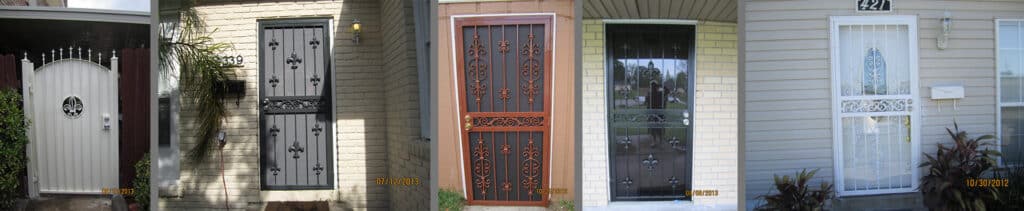
Our New Orleans security doors are engineered to resist forced entry at multiple points simultaneously. Steel frames are welded rather than screwed, reinforcing the weakest point of most entry doors. Multi-point locking systems engage at the top, middle, and bottom of the door simultaneously, preventing the pry-and-kick attacks that defeat single-point locks. Reinforced hinges with security studs prevent hinge-side attacks even when the door is open. For residential properties in neighborhoods with elevated property crime rates, a properly installed security door is one of the most effective physical deterrents available. We carry both full-panel steel security doors and decorative iron security doors that meet the same structural standards while maintaining curb appeal appropriate for New Orleans homes.
Storm Doors
Hurricane season runs from June through November, and the Gulf of Mexico positions New Orleans in the path of some of the Atlantic Basin’s most intense storms. Our New Orleans storm doors are impact-rated and pressure-tested to meet Miami-Dade County standards, the most rigorous hurricane-door certification available. These ratings mean the door assembly, including the frame, glazing, hardware, and weather seals, has been tested as a complete system against both impact from windborne debris and the positive and negative pressure cycles that occur during a hurricane. Storm doors also improve energy efficiency during New Orleans’ long cooling season by providing an additional barrier against heat and humidity at the threshold.
Double French Doors
French doors have been part of New Orleans’ residential architecture since the early 1800s. The classic Creole cottage facade typically featured four openings, often four full-length French door sets, allowing indoor-outdoor living that made sense in the subtropical climate long before air conditioning existed. Our New Orleans double French doors honor that tradition with period-appropriate proportions and glass configurations, available in wrought iron, steel, and aluminum frames with impact-resistant glass options for hurricane compliance. They work equally well on the street facade of a historic Bywater cottage and on the rear gallery of an Uptown home opening to a courtyard.
Patio Doors
Our New Orleans patio doors serve rear and side entries where sliding or swinging access to outdoor spaces is the priority. We install both sliding patio doors and hinged patio configurations, with frame materials selected to hold up against the humidity levels that make untreated wood swell, stick, and eventually fail in south Louisiana’s climate. Powder-coated steel and aluminum frames are standard recommendations for New Orleans patio applications.
Choosing the Right Door for New Orleans Conditions
The right door for a New Orleans home depends on four intersecting factors: hurricane performance, humidity resistance, security level, and architectural compatibility. Understanding how each factor applies to your specific property leads to a better selection and a longer-lasting installation.
Hurricane Season Performance
The key rating to understand is design pressure (DP), which measures the wind load a door assembly can withstand rather than raw wind speed. A door rated for Miami-Dade County impact standards has passed both impact testing (simulating windborne debris) and cyclic pressure testing (simulating the pressure fluctuations that happen as a hurricane passes). For New Orleans, any door installed in an exterior opening should carry a DP rating appropriate to the wind zone, and impact-rated glass is strongly recommended for any door with glazing. Non-impact doors can be supplemented with storm shutters for hurricane season, though a fully impact-rated assembly provides better long-term protection without the seasonal setup burden.
Humidity and Material Selection
New Orleans consistently ranks among the most humid cities in the United States, with average relative humidity above 75 percent year-round. Wood doors absorb that moisture, causing swelling, sticking, and eventual warping that breaks the seal between door and frame. Iron and steel doors do not warp. A powder-coated finish applied to iron or steel creates a protective barrier against the rust that bare metal would develop in the salt-air, high-humidity coastal environment. Aluminum frames are inherently rust-resistant. The combination of a steel or iron door with a powder-coated finish and a properly weatherstripped frame is the lowest-maintenance, longest-lasting option for New Orleans exterior openings.
Security Considerations
A door is only as secure as its weakest component. The door panel itself matters less than the frame it sits in: a solid steel panel mounted in a rotted wood frame offers minimal protection because the frame can be kicked out. A complete security upgrade addresses the frame (steel-reinforced or solid steel), the hinges (reinforced with non-removable hinge pins and security studs on the exterior side), and the locking system (multi-point engagement rather than a single deadbolt). Big Easy Iron Works assesses all three components during consultation and recommends frame reinforcement when the existing frame is inadequate for the door being installed.
Architectural Compatibility and HDLC Requirements
New Orleans has more locally designated historic districts than almost any other American city. Properties within HDLC-regulated areas, including the Vieux Carre (French Quarter), Garden District, Esplanade Ridge, Marigny, Tremé, and others, require a Certificate of Appropriateness (COA) before any exterior alteration, including door replacement. The HDLC distinguishes between in-kind replacement (same material, same configuration) which may qualify for administrative staff approval, and alterations (different material, different configuration) which require a full commission hearing. Big Easy Iron Works has experience working within HDLC guidelines and can assist with documentation showing that the proposed door matches the period character of the structure.
Iron and Steel Doors in New Orleans Historic Districts
The HDLC governs exterior alterations in over 20 designated historic districts across the city. For door replacements, the commission’s primary concern is whether the new door maintains the historic character of the building’s facade, which means proportions, materials, and design details must be consistent with the structure’s period of construction.
Wrought iron doors have been part of New Orleans’ architectural vocabulary for centuries, particularly in the French Quarter and Faubourg Marigny where ornamental ironwork defines the streetscape. Replacing an existing iron door with a new iron door of comparable design and proportion is typically the most straightforward path to HDLC approval. Steel doors that replicate period ironwork patterns can also qualify, particularly when the existing door is beyond repair and an in-kind material match is impractical.
For Garden District properties, the commission focuses on maintaining the Greek Revival and Italianate character of the neighborhood, where paneled wood doors with sidelights were historically common. Replacing these with iron or steel requires demonstrating design compatibility, typically through detailed drawings submitted with the COA application. Big Easy Iron Works can produce fabrication drawings appropriate for HDLC submission, showing the door’s panel configuration, glass placement, hardware location, and finish.
Properties in Esplanade Ridge, Bywater, and Tremé generally have Creole cottage and shotgun house stock, where French door configurations are historically appropriate and often preferred by the commission over solid-panel replacements. Our double French door options in wrought iron or powder-coated steel align well with HDLC expectations in these neighborhoods.
Door Installation Process
Every Big Easy Iron Works door installation follows a consistent process that prevents the common problems: doors that don’t hang square, frames that aren’t properly reinforced, and weatherstripping that fails within the first season.
- Measurement and consultation: We measure the rough opening, assess the existing frame condition, and discuss your performance needs, security requirements, and any HDLC constraints.
- Design selection or custom fabrication: For stock doors, we select from our inventory. For custom work, we produce fabrication drawings and confirm specifications before production begins.
- Old door removal: The existing door and hardware are removed carefully to avoid damaging the surrounding finish and trim.
- Frame inspection and repair: The rough opening is inspected for rot, pest damage, or structural compromise. Frame reinforcement is completed before the new door is set.
- Installation and shimming: The new door is set plumb and level, shimmed at hinge and lock points, and fastened through the frame into the structural framing.
- Weatherstripping and hardware: Door sweeps, compression seals, and threshold weatherstripping are installed for a weather-tight seal. Hardware is mounted and adjusted for smooth operation.
- Final inspection: The door is tested through its full range of motion, all locking points are checked for engagement, and the installation is reviewed for gaps or alignment issues before the job is closed.
New Orleans Door Cost Guide
Door costs in New Orleans vary significantly depending on material, size, customization level, and frame condition. The ranges below reflect typical installed costs, including removal of the existing door and standard frame preparation. Frame reinforcement or repair, if needed, adds to the total.
- Security doors: $800 to $2,500 installed, depending on whether the door is a stock steel unit or a custom-fabricated iron panel with decorative elements.
- Storm doors: $300 to $900 installed for aluminum-framed storm door units. Impact-rated assemblies with hurricane-grade glass start higher.
- Double French doors: $1,500 to $5,000 for standard configurations. Custom wrought iron French doors with ornamental panels can run significantly higher depending on complexity.
- Patio doors: $700 to $2,000 installed, depending on size and whether the unit is a sliding or hinged configuration.
Factors that push costs toward the top of any range include: non-standard rough opening sizes requiring custom fabrication, frame damage requiring structural repair, multi-point locking hardware upgrades, impact-rated glass, ornamental ironwork details, and powder-coat finishes in custom colors. We provide free estimates for all projects so you have accurate numbers before committing to any scope of work.
Neighborhoods We Serve
Big Easy Iron Works installs doors throughout the New Orleans metro area, including French Quarter, Garden District, Uptown, Bywater, Tremé, Mid-City, Lakeview, Gentilly, Algiers, and the Marigny. We also serve the surrounding metro including Metairie, Kenner, Gretna, Harvey, Westwego, Covington, Mandeville, Slidell, and LaPlace. HDLC-regulated properties in any designated historic district are welcome; our team is familiar with the approval process and documentation requirements across the commission’s jurisdictions.
Frequently Asked Questions
Are iron doors worth it in New Orleans?
For most New Orleans homeowners, yes. The core problem with standard wood exterior doors in this climate is moisture: the city’s high year-round humidity causes wood to swell, warp, and eventually fail the seal between door and frame. Iron and steel doors do not warp. A powder-coated iron door installed properly in a reinforced frame will outlast multiple wood door replacements, requires minimal maintenance beyond occasional cleaning, and simultaneously improves security over a wood panel. The upfront cost is higher, but the 20-plus year lifespan of a quality iron door makes it cost-competitive with cycling through wood doors every five to ten years. For properties in historic districts, wrought iron is also the historically appropriate material the HDLC expects, which simplifies the approval process.
Do I need HDLC approval to replace a door in New Orleans?
If your property is in one of New Orleans’ designated historic districts, including the French Quarter (Vieux Carre), Garden District, Esplanade Ridge, Marigny, Tremé, Bywater, or others, you generally need a Certificate of Appropriateness from the HDLC before replacing an exterior door. The process depends on what you’re changing. In-kind replacement, meaning same material and same configuration, can often be approved administratively by HDLC staff without a full commission hearing. Changes in material, configuration, or design typically require a commission review, which happens at scheduled monthly meetings. Properties outside designated historic districts do not face HDLC requirements, though building permits may still apply. Big Easy Iron Works can help you determine whether your property is in an HDLC district before you commit to any scope of work.
What is the most secure door for a New Orleans home?
The most secure configuration combines three elements: a steel-reinforced or solid steel frame anchored into structural framing rather than just the rough opening, a steel or heavy iron door panel rather than wood or fiberglass, and a multi-point locking system that engages at the top, center, and bottom of the door rather than a single deadbolt. Most residential break-ins involve kicking through the frame or prying a single-point lock open. A properly reinforced frame eliminates the kick-through vulnerability; multi-point locks eliminate the pry attack. Reinforced hinges with security studs on the hinge side of the door prevent the less common but real tactic of removing hinge pins on exterior-mounted hinges. Big Easy Iron Works installs all three elements as a complete security upgrade rather than just swapping the door panel.
What kind of storm door do I need for hurricane season in New Orleans?
For hurricane protection, look for impact-rated assemblies tested to Miami-Dade County standards, which is the benchmark certification for hurricane-prone coastal areas. The key distinction is between pressure-rated and impact-rated doors. Pressure-rated doors can handle the wind load of a hurricane but are not designed to stop windborne debris. Impact-rated doors pass both tests: they hold up under the pressure cycles of a hurricane and resist penetration from debris traveling at high velocity. The rating is assigned to the full assembly, including frame, glazing, hardware, and seals, not just the door panel. For New Orleans, any door with exterior glass should be impact-rated or supplemented with storm shutters during hurricane season. Your door’s design pressure (DP) rating indicates the wind load it can handle; consult Big Easy Iron Works for the appropriate DP rating for your home’s wind zone.
Can I get custom iron doors to match my historic New Orleans home?
Yes. Big Easy Iron Works fabricates custom iron doors designed to match the architectural character of specific properties, including period-appropriate panel configurations, glass placement, ornamental scrollwork, and hardware styles consistent with the building’s era. For HDLC submissions, we can provide fabrication drawings showing the door’s full design with dimensions, which is typically required as part of a Certificate of Appropriateness application. For French Quarter and Marigny properties where cast and wrought iron ornamental detail is historically prevalent, we offer designs that incorporate the scrollwork, fleur-de-lis, and geometric patterns associated with those neighborhoods. The custom process begins with a site visit to measure the opening and photograph the existing door and surrounding facade, giving us the reference material to design a door that fits the building’s character.
How long does door installation take in New Orleans?
For stock doors with a standard opening and a frame in good condition, a single exterior door installation typically takes three to five hours. Double door installations or configurations requiring frame reinforcement take longer, generally a full day. Custom-fabricated iron doors require lead time for fabrication before installation can be scheduled; that timeline depends on the complexity of the design and current production queue. If your project requires an HDLC Certificate of Appropriateness, the approval process runs on the commission’s meeting schedule and can take four to eight weeks depending on whether your application qualifies for administrative approval or requires a full commission hearing. Big Easy Iron Works will give you realistic timelines at the consultation stage so you can plan accordingly.
Do iron doors rust in the New Orleans climate?
Bare iron rusts, particularly in a coastal, high-humidity environment like New Orleans. However, properly finished iron doors do not rust under normal conditions. The standard protective finish for iron and steel doors in this climate is powder coating, which is an electrostatically applied polymer coating baked onto the metal surface. Powder coating is significantly more durable than paint and creates a continuous barrier that prevents moisture from reaching the metal. In coastal applications, a quality powder coat applied to properly prepared metal will prevent rust for decades with routine maintenance limited to cleaning with mild soap and water. If the finish is chipped or scratched, touching up the affected area promptly prevents the localized moisture exposure that leads to rust streaks. Big Easy Iron Works specifies powder-coat finishes on all iron and steel doors for New Orleans installations.
What is the difference between a security door and a storm door?
Security doors are designed primarily to resist forced entry, using heavy steel or iron construction, reinforced frames, and multi-point locking systems. Storm doors are designed primarily to resist wind and weather, using impact-rated assemblies tested against wind pressure and debris impact. There is some overlap: a heavy iron security door with impact-rated glass panels provides both security and storm protection. But a standard storm door, which is typically a lighter aluminum-framed unit with a full glass panel, provides minimal security compared to a dedicated security door. For properties in New Orleans where both concerns are real, the options are to install a security door rated for impact (combining both functions) or to layer a security door with storm shutters for hurricane season. Big Easy Iron Works can help you determine which approach is appropriate for your specific opening, budget, and risk priorities.
Why do doors stick and warp in New Orleans?
Wood absorbs moisture from the surrounding air, and in New Orleans, that air is almost always humid. As wood absorbs moisture, it expands. The expansion is not uniform across the door panel because different parts of the door (rail, stile, panel) expand at different rates and the frame constrains expansion at the edges. The result is a door that expands out of square, binding against the frame (sticking) or pulling away from it (gap at the top, hinge-side sag). Temperature cycling accelerates the problem because the wood contracts in cooler weather and expands again in warm weather, slowly fatiguing the joinery. Steel and iron doors are not affected by moisture absorption because metal does not absorb water the way wood does. Switching from a wood door to a steel or iron door permanently eliminates the sticking and warping cycle without requiring seasonal adjustment or refinishing.
How do I know if my door frame needs to be replaced?
Frame condition is the most important factor in a door installation and the most commonly overlooked one. Signs that a frame needs repair or replacement include: soft or spongy wood when you press on the frame with your thumb, visible discoloration or dark staining indicating moisture damage, visible gaps between the frame and the rough opening, and door jambs that are no longer plumb or square. In New Orleans, frame damage from moisture is common because wood frames in direct contact with the high-humidity exterior environment absorb water over years and eventually rot. At the corners of the frame and at the sill (bottom) are the highest-risk areas. Installing a new door in a damaged frame transfers the structural weakness to the new installation, which is why Big Easy Iron Works always inspects the frame before hanging a new door and recommends repairs when the frame cannot support the new installation reliably.
Can iron doors improve my home’s energy efficiency?
Yes, in two ways. First, iron and steel doors maintain a tighter seal than wood doors because they do not warp or swell with seasonal humidity changes. A door that holds its shape year-round keeps the weatherstripping compressed evenly around the full perimeter, which is where most energy loss at door openings happens. Second, storm doors, whether impact-rated or standard, add an additional air barrier at the threshold that reduces heat and humidity infiltration during the long New Orleans cooling season. The energy savings from a properly installed steel or iron door with quality weatherstripping versus an old warped wood door can be meaningful on a monthly utility bill basis. For homes relying heavily on central air conditioning from May through October, the cooling-season energy savings from a tight exterior door are typically the most noticeable impact.
Does Big Easy Iron Works handle both residential and commercial door installations?
Yes. Big Easy Iron Works installs doors for residential properties ranging from single-family homes and historic Creole cottages to multifamily buildings, as well as commercial applications including retail storefronts, office buildings, restaurants, and light industrial facilities. Commercial door specifications often differ from residential: commercial applications commonly require heavier-gauge steel, ADA-compliant hardware and clearances, and in some cases fire ratings. We assess commercial projects individually and specify materials and hardware appropriate to the application’s foot traffic, security requirements, and code obligations. Our experience with New Orleans’ historic commercial corridors, including Magazine Street, Frenchmen Street, and the CBD, means we are familiar with the aesthetic expectations and HDLC requirements that apply to commercial storefront alterations in designated districts.
Schedule a Free Estimate
If you are weighing iron versus steel, security versus storm, or navigating the HDLC approval process for a historic district property, Big Easy Iron Works can walk you through the options and give you accurate installed cost numbers for your specific opening. Call us at 504-732-0066 or request a free estimate online. We serve all of New Orleans and the surrounding metro, and we have been doing it for over 30 years.
Driving Directions
Big Easy Iron Works is 15 minutes away from Hurricane Katrina Memorial and 14 minutes from Joan of Arc Statue.
Business Information
Big Easy Iron Works
625 Celeste St Suite 504-E,
New Orleans, LA 70130
Phone: 504-732-0066