
Table of Contents
Wrought Iron Railings in New Orleans | Big Easy Iron Works
New Orleans homes sit on a different level than most. Literally. Raised shotgun houses, Creole cottages on pier-and-beam foundations, and century-old Uptown doubles all share steep front steps that drop straight to the sidewalk, making a solid, well-installed railing not a design option but a daily necessity. At Big Easy Iron Works, we fabricate and install custom wrought iron railings across greater New Orleans, from French Quarter balcony galleries to Metairie subdivision decks, working with homeowners, landlords, and commercial property managers who want ironwork built to last in Louisiana’s heat and humidity. Call us at 504-732-0066 for a free estimate.
Types of Iron Railings We Install
New Orleans properties present every railing scenario imaginable, from a single-step front stoop on a Bywater shotgun to a sweeping second-floor balcony gallery in the Garden District. We fabricate and install all of the following railing types.
Interior Stair Railings
Inside the home, stair railings need to be structurally sound without dominating the room. We fabricate interior iron railings in both straight runs and curved configurations, with options for decorative balusters, forged newel posts, and integrated wood or wrought iron handrails. Interior work is finished with flat or satin powder coat to minimize glare and match interior color schemes. We also fabricate half-wall and knee-wall railings for open loft areas and mezzanines common in converted New Orleans warehouses and commercial spaces.
Exterior Porch Railings
Raised homes in New Orleans neighborhoods like Gentilly, Lakeview, and Mid-City often have front porches three to five steps above grade, putting residents and guests at real fall risk without proper railings. We install exterior porch railings in standard picket, scrollwork, and spear-top profiles, all finished with industrial powder coat rated for outdoor exposure. Exterior porch railings meet IRC (International Residential Code) requirements of 36 inches minimum height for residential applications and 4-inch maximum baluster spacing to prevent child entrapment.
Balcony Gallery Railings
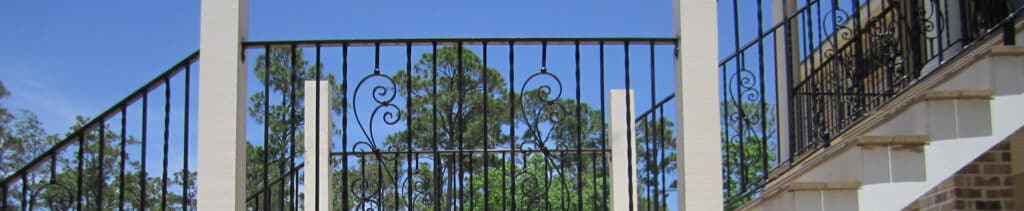
The signature wrought iron balcony galleries of the French Quarter and Garden District are what most people picture when they think of New Orleans iron. These overhanging second-floor railings, with their lacy scrollwork patterns and fleur-de-lis finials, have defined the city’s architectural identity since the mid-1800s. We replicate period-accurate gallery railing patterns for historic restorations and fabricate custom designs for new construction that honors the tradition. Gallery railings require deeper post anchorage and heavier gauge material than ground-level railings, and our fabrication reflects those structural demands.
Deck Railings
Suburban New Orleans homes in Metairie, Kenner, River Ridge, and Harahan increasingly feature rear decks and outdoor living spaces where standard treated lumber railings deteriorate quickly in the humidity. Iron deck railings give these spaces a permanent, low-maintenance perimeter that never rots, splinters, or needs seasonal re-staining. We install deck railings in both classic ornamental profiles and clean modern flat-bar designs, with post spacing engineered for the specific deck structure and load requirements.
ADA-Compliant Railings
Commercial properties, multi-family buildings, and any residential construction subject to ADA guidelines require railings with specific graspable profiles: a round cross-section with a 1.25- to 1.5-inch outside diameter, continuous along the full stair run, with returns at the top and bottom. We fabricate ADA-compliant iron handrails for churches, restaurants, medical offices, apartment stairwells, and any property where accessibility is a legal requirement. These railings are engineered to the 200-pound concentrated load standard required by code without sacrificing the finished iron aesthetic that fits New Orleans architecture.
Pool and Landscape Railings
Outdoor iron railings are not limited to porches and balconies. We install railings along pool deck perimeters, garden stairways, landscape retaining wall steps, and sloped yard paths where footing can be unstable after rain. Pool surround railings use the same marine-grade powder coat finish we apply to all outdoor ironwork, providing corrosion resistance in chlorinated and salt-air environments common in the greater New Orleans area.
Railing Design Styles for New Orleans Homes
The right railing design depends on the architectural style of the property and the neighborhood context. We offer five core design directions, with full custom fabrication available for any project that requires a pattern match to existing ironwork.
French Quarter lacy ironwork uses repeating scrollwork panels with fine vertical pickets, fleur-de-lis accents, and curved top rails. This pattern is closely associated with the cast iron galleries of Royal Street and the Pontalba Buildings on Jackson Square, and it remains the most requested style for balcony gallery restorations in the Vieux Carré.
Garden District Victorian scrollwork features larger, bolder scroll elements with more spacing between pickets. This style complements the Greek Revival and Italianate homes throughout the Garden District and Uptown, where lot sizes and setbacks give railings room to make a visual statement from the street.
Plantation-style simple picket uses straight vertical pickets with minimal ornamentation and a clean top rail, appropriate for raised Creole cottages, traditional four-square homes, and any property where a restrained, historically accurate look is preferred.
Modern minimalist flat bar replaces round pickets with flat rectangular bar stock in a horizontal or vertical pattern, giving contemporary homes and converted commercial spaces a sleek, industrial-influenced railing that reads as clearly intentional rather than out of place.
Custom pattern match is available for any project where existing ironwork on the property sets the design standard. We photograph and measure the existing pattern, fabricate matching sections, and weld them to new posts so the addition is indistinguishable from the original.
Iron Railings in New Orleans Historic Districts
New Orleans has more locally protected historic districts than nearly any other American city, and several of them have specific review requirements for any exterior work, including railing installation or replacement. Understanding which body governs your property before starting fabrication saves time and prevents costly rework.
The Vieux Carré Commission (VCC) governs the French Quarter. Any exterior modification to a property within the French Quarter, including railing replacement, new balcony railings, or stair railing installation, requires VCC pre-approval before work begins. The VCC reviews design drawings against established guidelines for the neighborhood and may require that new ironwork match historic patterns documented for the area. The review process typically takes several weeks.
The Historic District Landmarks Commission (HDLC) governs New Orleans’ other locally designated historic districts, including Esplanade Ridge, Tremé, Bywater, portions of the Garden District, and others. HDLC issues a Certificate of Appropriateness for any exterior alteration. Like the VCC, HDLC evaluates railing designs against period-appropriate guidelines, favoring wrought iron profiles that reflect the construction era of the neighborhood.
Big Easy Iron Works works with homeowners and property managers throughout both VCC and HDLC review processes. We prepare design drawings in the format required for submissions, document material specifications, and adjust patterns to meet commission feedback. Properties subject to historic review should allow additional lead time before the start of fabrication.
Beyond VCC and HDLC districts, the New Orleans iron tradition itself shapes what looks right on a given block. The Cornstalk Hotel fence on Royal Street, with its celebrated cast iron corn, morning glory, and butterfly pattern, is one of the most cited examples of how 19th-century iron fabrication defined the character of specific New Orleans addresses. Even outside formal review districts, matching the ironwork character of the block adds property value and neighborhood continuity.
Railing Cost in New Orleans
Railing costs in New Orleans vary based on railing type, custom design complexity, total linear footage, site access conditions, and chosen finish. The following ranges reflect installed pricing for iron railings fabricated and installed by Big Easy Iron Works.
Interior stair railings: $150 to $400 per linear foot installed. Simpler straight-run railings with standard pickets fall toward the lower end. Curved stairs, custom forged balusters, and ornate newel posts push costs toward the higher range.
Exterior porch railings: $120 to $350 per linear foot installed. Single-level front porch railings with standard profiles are among the most straightforward iron railing installations. Properties with brick or concrete steps requiring core-drilled post anchors add to labor cost.
Balcony gallery railings: $200 to $500 per linear foot installed. Gallery railings require heavier structural components and more elaborate fabrication for lacy or scrollwork panels. Historic pattern replication and VCC submission drawings are factored into these projects individually.
ADA-compliant commercial handrails: $100 to $250 per linear foot installed. These are simpler in profile than decorative residential railings but require precise fabrication to meet dimensional standards.
Factors that affect final cost include total project length, design complexity, whether existing railing needs removal and disposal, substrate type (wood framing vs. concrete vs. masonry), powder coat color selection, and any VCC or HDLC documentation required. We provide free on-site estimates so you receive a firm project price before any work begins.
Neighborhoods We Serve
Big Easy Iron Works installs iron railings throughout the New Orleans metro area. We regularly work in the following locations.
Orleans Parish: French Quarter, Garden District, Uptown, Bywater, Tremé, Mid-City, Lakeview, Broadmoor, Gentilly, Algiers, Marigny, Esplanade Ridge, Carrollton, Hollygrove
Jefferson Parish: Metairie, Kenner, River Ridge, Harahan, Gretna, Westwego, Avondale, Marrero
Northshore: Covington, Mandeville, Madisonville, Slidell, Abita Springs
Whether your property is a Victorian double in Tremé requiring an HDLC-reviewed railing replacement, a Kenner subdivision home needing a deck railing, or a Mandeville commercial property requiring ADA-compliant stair rails, we provide the same licensed fabrication and installation process. Call 504-732-0066 to schedule a free estimate at your location.
Frequently Asked Questions
How much do wrought iron railings cost in New Orleans?
Installed wrought iron railing costs in New Orleans typically range from $120 to $500 per linear foot depending on the railing type and design complexity. Interior stair railings with standard profiles run $150 to $400 per linear foot. Exterior porch railings for raised homes start around $120 and reach $350 per linear foot for ornate work. Balcony gallery railings with scrollwork patterns range from $200 to $500 per linear foot, reflecting the heavier structural requirements and more intricate fabrication involved. ADA-compliant commercial handrails are simpler in cross-section and typically run $100 to $250 per linear foot installed. Site conditions, including whether posts anchor into wood framing, concrete, or masonry, also influence final cost. We offer free on-site estimates with firm pricing before any work begins.
How long do iron railings last in New Orleans?
Properly fabricated and finished iron railings last 50 years or more, and many historic iron railings in the French Quarter have been in continuous service for 100 to 150 years. The key factor in longevity in New Orleans’ climate is the finish. Bare or paint-only iron railings in the city’s humidity and heat will show surface rust within a few years without regular maintenance. Railings finished with industrial powder coat, which bonds the finish to the metal at the molecular level rather than simply coating the surface, perform significantly better outdoors, resisting corrosion for 10 to 15 years before a re-coat is warranted. Interior railings with powder coat or quality paint last even longer. Annual inspection for chips, scratches, or areas of bubbling finish lets you catch and address potential rust entry points before they become structural problems.
Do I need a permit to install railings in New Orleans?
In most cases, railing installation in Orleans Parish requires a building permit from the City of New Orleans Department of Safety and Permits. Properties within the French Quarter additionally require pre-approval from the Vieux Carré Commission (VCC) before exterior work begins, and properties in other locally designated historic districts, including Tremé, Bywater, Esplanade Ridge, and portions of the Garden District, require a Certificate of Appropriateness from the HDLC. The permit and review process adds lead time to projects in historic areas, so it is important to factor in commission review schedules when planning railing installation. We assist clients with design documentation for VCC and HDLC submissions. Jefferson Parish properties follow Jefferson Parish permit requirements, which are separate from Orleans Parish rules.
What is the difference between wrought iron and cast iron railings?
Cast iron is poured into molds, producing heavier, more ornate sections but a material that is brittle under bending or impact stress. The elaborate gallery railings of the French Quarter from the 1830s through the 1880s are largely cast iron, valued for the complexity of their repeating floral and geometric patterns. Wrought iron is worked and welded by fabricators, producing a stronger, more ductile material that holds up better under the physical stress of daily use. True wrought iron is no longer commercially produced. What is fabricated today as ornamental or wrought iron railing is mild steel processed using the same hand-forming and welding techniques that historically defined the craft, producing a product indistinguishable in appearance from historical wrought iron and stronger in structural performance than cast iron.
Can iron railings rust in New Orleans’ climate?
Yes, unprotected or poorly finished iron railings will rust in New Orleans. The combination of high annual rainfall, humidity that regularly exceeds 80%, proximity to tidal water in many neighborhoods, and salt air near Lake Pontchartrain or the river creates an aggressive corrosion environment for bare metal. The standard solution is industrial powder coat applied over a zinc-phosphate primer, which seals all surfaces and welds against moisture infiltration. Powder coat holds up significantly better than brush-applied paint in outdoor conditions and is the finish we apply to all exterior iron railings. For railings in especially exposed locations, such as open balconies facing prevailing wind or properties near the lakefront, we recommend annual inspection and touch-up of any chipped areas before rust can establish.
What railing height is required by code in New Orleans?
Under the International Residential Code (IRC), which Louisiana has adopted, residential railings on surfaces more than 30 inches above grade must be at least 36 inches high. For commercial properties and multi-family residential buildings governed by the International Building Code (IBC), the minimum railing height on most elevated surfaces is 42 inches. Balusters must be spaced so that a 4-inch sphere cannot pass between them, preventing child entrapment. ADA-compliant handrails must have a graspable profile of 1.25 to 1.5 inches in outside diameter for round cross-sections. All railings we fabricate and install meet or exceed applicable code requirements for the property type and jurisdiction, and our estimates include specifications so you can confirm compliance before installation begins.
How do I maintain iron railings in New Orleans?
Iron railing maintenance in New Orleans comes down to keeping the finish intact so moisture cannot reach bare metal. Annually, clean railings with mild soap and water using a soft cloth or brush, rinse thoroughly, and inspect every inch of the surface for chips, scratches, bubbling, or any area where the powder coat or paint has lifted. Touch up small damaged areas promptly with a rust-inhibiting primer followed by matching paint. For powder-coated railings, a full professional re-coat every 10 to 15 years restores full corrosion protection. Interior railings require far less attention: dusting and occasional damp wipe-down keeps the finish in good condition indefinitely. Avoid harsh chemical cleaners, abrasive pads, or pressure washing at close range, which can damage the protective finish and accelerate corrosion.
Can I get custom railing patterns to match my historic New Orleans home?
Yes. Pattern matching is one of the most common requests we receive, particularly from homeowners in the Garden District, Uptown, and Tremé who are replacing deteriorated sections of existing ironwork and need the new sections to be visually continuous with what remains. We photograph the existing pattern, take measurements of the repeat unit, and fabricate matching sections using the same gauge material and welding techniques as the original. For VCC and HDLC projects where historic accuracy is a review criterion, we document the pattern and material specification as part of the submission package. If the existing railing has unique or non-standard elements, we fabricate custom jigs to reproduce those elements consistently across the new run.
What is a balcony gallery railing in New Orleans?
A balcony gallery in New Orleans is an overhanging second-floor balcony, typically cantilevered over the sidewalk on French Quarter buildings or set back behind columns in Garden District homes, that runs along the full front facade of the building. The ironwork railing that lines the gallery edge is the defining architectural element of this feature, and in the French Quarter it is the scrollwork, lacy panels, and cast or wrought iron detail of these gallery railings that defines the visual character of the street. Installing or restoring a gallery railing is a more complex project than a simple stair railing because the structural connection to the building must support both the railing and the load of people using the balcony, and in historic districts it must satisfy commission review requirements for period-appropriate design.
Do you fabricate railings in-house or use prefabricated panels?
We fabricate iron railings in-house at our New Orleans shop. This gives us full control over material quality, weld integrity, post sizing, and design accuracy. Prefabricated railing panels are available from supply houses in standard lengths and patterns, but they are designed for generic applications and rarely match the specific dimensions, patterns, or post spacing that New Orleans properties require. In-house fabrication also means we can produce one-of-a-kind sections, match existing patterns, accommodate irregular measurements, and adjust designs at the custom fitting stage without waiting for a third-party supplier. The cost difference between prefabricated and custom fabricated is often smaller than homeowners expect, particularly for projects with any non-standard dimensions or design requirements.
Can you install railings on brick or concrete steps?
Yes. Many New Orleans homes have brick or concrete entry steps, particularly raised brick-front homes in Mid-City, Uptown, and Metairie. Installing iron railing posts in brick or concrete requires core drilling and setting posts in an epoxy or non-shrink grout anchor system, which creates a connection at least as strong as a wood-framed anchor. We use masonry core drilling equipment sized for the post diameter and the step substrate, and we seal the anchor point after installation to prevent water infiltration into the core hole. Properties with historic brick steps that should not be drilled can also be accommodated with surface-mount post bases. We assess the substrate at the estimate visit and recommend the most appropriate anchor method for each installation.
How long does railing installation take?
A straightforward exterior porch railing installation on a raised New Orleans home typically takes one day for fabrication and one day for installation. Larger projects, multi-run installations, or jobs requiring masonry core drilling and epoxy curing take two to four days. Projects in VCC or HDLC districts add the commission review period, which can range from two to six weeks depending on the review schedule and whether revisions are requested. We provide a project timeline at the estimate stage so you can plan around the installation window. Powder coat curing takes approximately 24 to 48 hours before the railing is in full service condition.
Ready to move forward with a free estimate? Contact Big Easy Iron Works at 504-732-0066 or visit our contact page to schedule a site visit. We serve property owners throughout New Orleans, Jefferson Parish, and the North Shore, and we stand behind every railing we fabricate and install.