
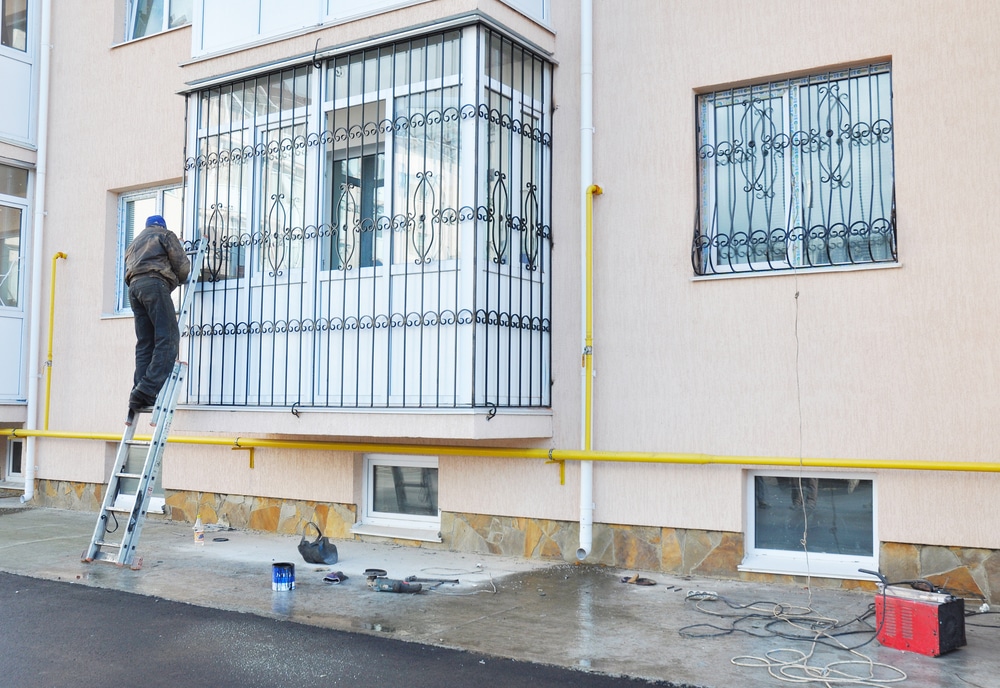
Windows are the most commonly exploited entry point in residential break-ins, and in a city like New Orleans, where neighborhoods range from densely packed French Quarter blocks to sprawling Lakeview ranch homes, picking the right type of window security bar matters as much as installing one in the first place. The wrong choice, such as welding permanent bars onto a bedroom window without a quick-release mechanism, can turn a security measure into a fire hazard. The right choice, one matched to your window type, neighborhood aesthetic, and Louisiana fire code requirements, can protect your home for decades with almost zero maintenance.
This guide covers every type of window security bar available, how they differ in protection level and installation method, what Louisiana law requires for bedroom egress, and how historic district homeowners in New Orleans navigate HDLC and VCC approval. If you are ready to talk options, the team at Big Easy Iron Works security systems in New Orleans custom-fabricates and installs security bars across the metro area.
Fixed (Permanent) Window Security Bars
Fixed window security bars are the strongest and most tamper-resistant option available. They are welded or bolted directly to the window frame, the surrounding masonry, or the structural framing of the wall, depending on the construction type of your home. Once installed, they do not move. There is no latch, no hinge, no release mechanism, and no gap for a pry bar to find purchase.
Most fixed bars are fabricated from mild steel, although Big Easy Iron Works also works in wrought iron for clients who want traditional New Orleans ironwork character. Both materials are finished with a polyester powder coat that bonds to the metal surface at high temperature, creating a skin that resists rust, UV degradation, and the coastal humidity that accelerates corrosion in Gentilly, Lakeview, and lakefront neighborhoods where salt air is a real concern.
From a deterrence standpoint, fixed bars are unmatched. A would-be intruder approaching a window protected by welded steel bars knows immediately that entry through that window is not happening quietly or quickly. There is no amount of leverage that removes a properly anchored fixed bar set without cutting equipment and significant noise. This visible permanence is precisely why fixed bars remain the most requested type for ground-floor windows in Mid-City, Central City, and Algiers neighborhoods where NOPD response times are slower and neighbors may not be immediately aware of a break-in attempt.
The trade-off with fixed bars is exactly what the name implies: they are fixed. You cannot open them for ventilation, and no one inside can exit through that window in an emergency. This is why Louisiana fire code has specific requirements about where fixed bars may legally be installed, which we cover in the egress section below.
Fixed bars work well for:
- Basement windows and foundation-level openings
- Ground-floor living room and kitchen windows
- Windows in vacant or rental properties
- Commercial properties and storefronts
- Any window that is not a designated bedroom egress point
Removable Window Security Bars
Removable window security bars mount into receiver brackets that are permanently anchored to the window frame. The bars themselves drop into the brackets and can be lifted out by someone who knows the release sequence, typically a pin or a keyed latch accessible only from the interior. From the outside, they look identical to fixed bars. The bars cannot be removed from the exterior without destroying the frame or cutting the bars themselves.
This design makes removable bars popular with renters who want strong security without making permanent modifications to a property they do not own. The brackets stay when the tenant leaves; the bars can go with them to the next rental. Property managers in the Marigny and Bywater, where shotgun doubles and camelback houses attract short-term renters who want protection without lease-violation risk, often install removable bar systems building-wide.
Removable bars are also practical for homeowners who use certain windows for ventilation during the cooler months. A window that needs to be fully opened to let in lake breezes in October can be secured in the removable bar system from November through August, then freed up when the weather allows.
One important note: the protection level of a removable bar system depends entirely on the quality of the bracket mounting. Brackets screwed only into window trim offer minimal resistance. Brackets lag-bolted into structural framing or masonry anchors embedded in brick offer resistance comparable to fixed bars. Always ask your installer how the brackets are anchored, not just how the bars release.
Hinged Security Bars with Quick-Release: The Louisiana Fire Code Standard
Hinged security bars, also called swing-away bars or quick-release bars, are the configuration required by Louisiana fire code for any window designated as a bedroom egress point. Under the Louisiana State Fire Marshal’s residential fire safety rules, which draw from NFPA 101 (the Life Safety Code), any window bar installed on a sleeping room window must include a quick-release mechanism that allows occupants to open the bars from the inside without a key and without special knowledge, even in smoke-filled, low-visibility conditions.
In practice this means the bar set pivots on a heavy-duty hinge at one side and latches at the other with a mechanism that opens with a single motion. The most common designs use a barrel bolt, a panic latch, or a lever handle that releases the bar set so it swings outward, clearing the window opening entirely. The release requires no tools and no key. A child who has been shown the mechanism once should be able to operate it under stress.
Hinged bars carry a misconception that they are weaker than fixed bars. This is not accurate when the hinge and latch hardware are properly specified. A 3/4-inch steel hinge pin with a welded barrel and a hardened latch bar resists forced entry as well as a fixed mount on the latch side. The hinge side is the potential weak point, which is why quality fabricators weld the hinge directly to the bar frame rather than bolting it, and use oversized hinge pins that cannot be driven out with a hammer from the exterior.
Every bedroom window bar installed by Big Easy Iron Works in New Orleans includes a quick-release hinge system as standard. We do not install fixed, non-releasing bars on bedroom windows, period. This is both a code compliance matter and a basic life-safety principle.
Window Security Grates vs. Individual Bars: What Is the Difference?
The terms “security bars” and “security grates” are often used interchangeably in casual conversation, but they describe meaningfully different products.
Individual security bars are parallel rods or flat bars spaced at regular intervals across the window opening. The spacing between bars is typically 4 to 5 inches, narrow enough that an adult cannot pass a shoulder through but wide enough to allow reasonable visibility and airflow. The bars run in one direction only, either vertically or horizontally.
A security grate is a welded grid pattern where horizontal members are welded across the vertical bars (or vice versa) at regular intervals, creating a rigid matrix. Grates are stronger than simple parallel bars because each intersection weld adds a structural node that resists both lateral and torsional force. Trying to spread two bars on a grate requires overcoming not just the bend resistance of each bar but also the weld holding the cross-member in place.
Ornamental ironwork almost always takes the grate form, because the grid pattern allows scrollwork, pickets, and decorative elements to be incorporated at the intersection points. A simple parallel-bar system is more utilitarian and costs less to fabricate. For maximum protection on a ground-floor window with no aesthetic requirement, a welded grate in 1/2-inch solid steel rod is the most robust option available without moving into commercial security grilles.
Ornamental vs. Flat Bar Security Bars: Aesthetics, Cost, and HDLC Implications
Security bars do not have to look like a jail cell, and in New Orleans they often cannot, because the Historic District Landmarks Commission (HDLC) and the Vieux Carre Commission (VCC) regulate the appearance of exterior modifications to structures within their jurisdictions. Properties in the French Quarter, Marigny, Tremé, Bywater, and portions of Uptown and the Garden District may require commission review before exterior security bars are installed.
Ornamental security bars incorporate decorative elements that have been part of New Orleans architectural identity for more than two centuries. Scrolls, fleurs-de-lis, spear points, and cast iron rosette inserts are common motifs. Because Big Easy Iron Works fabricates bars in-house, we can match existing ironwork patterns on a historic home, replicate period-appropriate designs for HDLC submissions, or create custom motifs that satisfy the commission’s design review criteria while still meeting the structural requirements for security.
Flat bar systems use rectangular or round steel bar stock in clean, unadorned lines. They are less expensive to fabricate, faster to install, and appropriate for modern architecture or for windows that are not visible from the street and therefore outside the visual jurisdiction of HDLC review. A rear-courtyard window in the French Quarter may not require HDLC approval for a simple flat-bar system if it is not visible from the public right of way, though confirming this with the commission before installation is always advisable.
Cost difference: ornamental bars run roughly 40 to 60 percent more than flat-bar systems of equivalent coverage area, because of the additional fabrication time for scrollwork and decorative elements. For homeowners subject to HDLC review, this premium is not optional: the commission will not approve a utilitarian flat-bar system on a primary street-facing facade in the French Quarter, and installing without approval can result in a mandatory removal order.
Security Bar Materials: Steel vs. Wrought Iron vs. Aluminum
The material your security bars are made from determines their strength, their maintenance requirements, and how long they will perform in New Orleans’ aggressive climate.
Mild steel is the industry standard for residential security bars. It is strong, weldable, available in a wide range of bar profiles, and significantly less expensive than wrought iron. Properly powder-coated mild steel resists corrosion for 15 to 20 years in a coastal environment before refinishing is needed. The limitation is that mild steel will rust aggressively if the powder coat is breached and left untreated. Annual inspection for chips, scratches, or surface rust, followed by touch-up with a rust-inhibiting primer, keeps mild steel bars in service indefinitely.
Wrought iron is the traditional material for New Orleans ironwork and carries a different corrosion profile than mild steel. True wrought iron (a low-carbon iron-slag composite, not to be confused with mild steel often marketed as “wrought iron”) is actually more corrosion-resistant than mild steel at the raw metal level, because the slag inclusions within the iron grain structure interfere with the electrochemical corrosion pathway. Wrought iron is rarely used in new fabrication today because it is difficult to source and expensive to work; most “wrought iron” bars sold and installed today are mild steel finished to look traditional. Big Easy Iron Works can work in both materials and will specify clearly which is used.
Cast iron is brittle and not appropriate for security applications. It is found in historic decorative grilles on pre-20th century New Orleans buildings but should not be specified for new security bar fabrication. A cast iron bar struck with a hammer will fracture; a mild steel bar will bend.
Aluminum is lightweight, corrosion-resistant, and inexpensive, but it is also soft. An aluminum security bar can be cut with a standard hacksaw in under two minutes. Aluminum window bars may deter opportunistic intruders but offer little resistance to a determined burglar with basic tools. Big Easy Iron Works does not recommend aluminum for residential security applications in high-crime neighborhoods. Aluminum may be appropriate for secondary deterrence on upper-floor windows where physical access is already difficult.
Galvanic corrosion is a concern when dissimilar metals are in contact in a humid environment. Steel bars mounted to aluminum window frames, or aluminum brackets used with steel bars, create a galvanic couple that accelerates corrosion at the contact point. Use isolating gaskets or specify all-steel hardware when mounting steel bars to aluminum frames.
Window Security Bars for Historic New Orleans Homes
New Orleans has one of the largest concentrations of pre-1900 residential architecture in the United States. The French Quarter alone contains thousands of structures on the National Register of Historic Places. The Garden District, Uptown, and Tremé add thousands more. Homeowners in these areas face a dual requirement: the security bar must be strong enough to protect the home, and it must be visually compatible with the architectural period and character of the structure.
The HDLC reviews exterior modifications to contributing structures in its designated historic districts. The VCC has jurisdiction over the French Quarter and is generally considered the stricter of the two bodies. Both commissions evaluate window bar applications based on material, finish, pattern, and visual impact. Neither commission will approve bars that are architecturally incompatible with the period of the structure, but both have approved well-designed ornamental ironwork on hundreds of historic New Orleans homes.
The process for a historic district bar installation typically involves:
- Submitting design drawings to the applicable commission (HDLC or VCC)
- Demonstrating that the bar design is compatible with existing ironwork on the structure or with period-appropriate precedents in the district
- Using materials and finishes consistent with historic practice (painted iron or steel, not unpainted galvanized or aluminum)
- Receiving a Certificate of Appropriateness before installation begins
Big Easy Iron Works has extensive experience with HDLC and VCC submissions. We prepare design drawings as part of our project process for historic district clients and can advise on precedent designs that have received commission approval for similar structures in the French Quarter, Marigny, Tremé, and Garden District.
Security Bars for Different Window Types
Not all windows accept security bar systems the same way. The window’s operating mechanism affects how bars are mounted, whether a hinged system is required, and what clearances need to be maintained.
Double-hung windows are the most common window type in older New Orleans homes. Both sashes slide vertically. Security bars can be mounted to the exterior frame without interfering with the sash operation. A fixed or removable bar set is appropriate for living areas; a hinged system is required for bedrooms.
Casement windows are hinged at the side and crank outward. A fixed exterior bar set will prevent the window from opening at all, which may be acceptable for non-egress windows. For casement windows that need to open for ventilation, the bar set should hinge on the same side as the window’s hinge so both the window and the bars can swing open together. This requires careful planning during fabrication to ensure the bar set clears properly when opened.
Sliding windows operate like a horizontal double-hung. Bars can be mounted to the exterior frame in a fixed or removable configuration. The bar spacing should account for the window’s track, so bars do not interfere with cleaning access to the track.
Awning windows hinge at the top and crank outward at the bottom. These are common in mid-century Lakeview and New Orleans East ranch-style homes. Fixed bars on awning windows block the window from opening. A hinged bar system that swings downward, hinging at the bottom frame, allows the window to open above the bar set. This is a less common configuration and requires custom fabrication.
Jalousie windows, found in many postwar New Orleans homes, use horizontal glass slats that crank open. These windows offer almost no security even when closed, because the slats can be removed by hand. A fixed security bar grate over the entire jalousie frame is the correct approach; the bars effectively replace the security function the window does not provide.
Louisiana Fire Code Requirements: Egress from Bedrooms
Louisiana’s State Fire Marshal adopts and enforces the International Residential Code (IRC) and references NFPA 101 for life safety requirements in residential occupancies. The relevant rule is straightforward: every sleeping room must have at least one operable emergency escape and rescue opening. A window is the most common egress point.
If security bars are installed on a bedroom window that serves as the room’s required egress opening, those bars must have a quick-release mechanism that:
- Operates from the interior without a key
- Can be activated with a single motion
- Does not require special knowledge or tools
- Allows the bars to fully clear the window opening when released
This requirement applies to bars on any floor, not just ground level. A second-floor bedroom window with bars installed as a deterrent against roof-level entry (common in New Orleans shotgun doubles with side galleries) still requires a quick-release system if that window is the room’s egress opening.
The Louisiana State Fire Marshal can cite homeowners who install non-releasing bars on bedroom windows, and more importantly, non-releasing bars on bedroom windows have contributed to deaths in residential fires. The added cost of a hinged quick-release system over a fixed system is modest, typically 15 to 25 percent of the bar fabrication cost. It is never worth skipping.
A note for landlords: Louisiana law (RS 9:3221) places responsibility for code-compliant security hardware on the landlord in rental properties. If you rent property with window bars, confirming that bedroom windows have NFPA 101-compliant quick-release mechanisms is your legal and ethical obligation.
Cost of Window Security Bars in New Orleans
Security bar pricing varies significantly based on bar type, material, window size, and ornamental complexity. The ranges below reflect typical installed costs in the New Orleans metro area as of 2025. Supply and labor costs fluctuate, so contact Big Easy Iron Works at 504-732-0066 for a current project estimate.
Flat bar fixed systems: $150 to $350 per window for standard residential sizes (up to 36 x 48 inches). Larger windows, thicker bar stock, or custom spacing adds to this base.
Removable bar systems: $200 to $450 per window including the bracket set. The bracket anchoring method (trim-mounted vs. structural anchor) significantly affects both cost and protection level.
Hinged quick-release systems: $250 to $500 per window. The hinge hardware, latch mechanism, and additional fabrication time account for the premium over fixed bars.
Ornamental bar systems: $400 to $900+ per window, depending on design complexity. Custom scrollwork, cast iron inserts, or historically matched patterns for HDLC/VCC submissions are at the higher end.
Whole-home packages: Installing bars on all ground-floor windows in a typical New Orleans double shotgun (6 to 10 windows) runs $1,200 to $4,500 depending on bar type and design. Multi-window projects receive volume pricing.
Professional installation is strongly recommended over DIY for one primary reason beyond code compliance: the anchoring. Security bars that are not anchored into structural framing or masonry with properly specified fasteners will fail under determined attack, regardless of bar quality. A $400 ornamental bar set anchored with 1-inch wood screws into window trim offers less real security than a $150 flat-bar set lag-bolted into the framing.
Please note: The prices in this article are estimates only, shared to help you plan. Your actual cost depends on your property, the materials and the size of the job. For pricing on your project, call Big Easy Iron Works for a quote.
Professional Installation vs. DIY Window Bars
Pre-fabricated window bar kits are sold at home improvement stores for $60 to $150. They are made from lighter bar stock than custom-fabricated bars, they come in fixed sizes that may not match your window dimensions, and they are anchored with hardware designed for the mounting method easiest for a homeowner to execute, which is usually screwing into window trim. In New Orleans’ predominantly older housing stock, where window frames are often cypress or heart pine (dense, but not structural), trim mounting can work loose over time, especially where wood has absorbed seasonal moisture.
Custom-fabricated bars from a local ironworks fabricator offer three advantages over pre-made kits: the bar stock is heavier, the design fits the window exactly (no gaps at the sides that a pry bar can exploit), and the installer anchors into structural framing or masonry. For a home in a neighborhood with elevated burglary rates, the $100 to $200 additional cost per window for professionally fabricated and installed bars is money well spent.
DIY installation may be appropriate for rental properties or secondary deterrence on upper-floor windows where the bars serve a visual deterrence function rather than as the primary physical barrier. In these cases, ensure the bars are still anchored with 3-inch or longer fasteners into framing, not trim, and that any bedroom window bar includes a proper quick-release mechanism regardless of who installs it.
Maintaining Iron Window Bars in New Orleans’ Humid Climate
New Orleans sits in USDA Hardiness Zone 9a, with average annual humidity between 75 and 80 percent and regular exposure to salt-laden air from Lake Pontchartrain and the Gulf. This climate accelerates oxidation of ferrous metals significantly faster than in drier inland cities. A security bar installation that might last 20 years in Dallas without maintenance may begin showing surface rust in New Orleans within 3 to 5 years if not properly maintained.
The maintenance protocol for powder-coated steel bars in a New Orleans climate is not complicated, but it must be consistent:
- Annual inspection: Check the entire bar surface for chips, scratches, or areas where the powder coat has lifted. Pay particular attention to weld seams and areas where the bar contacts the mounting hardware, as these are where coating damage is most likely to begin.
- Touch-up at first sign of rust: Do not wait until rust blisters appear. At the first sign of surface rust (orange staining under the powder coat), wire-brush the affected area, apply a zinc-based rust-inhibiting primer, and follow with a matching color topcoat. Most powder coat colors can be approximated with oil-based enamel for small touch-up areas.
- Cleaning: Wash bars twice yearly with a mild detergent solution to remove salt deposits and organic material (moss, mildew) that trap moisture against the metal surface. A pressure washer on low setting is effective; do not use wire brushes on areas that are not yet rusting, as they scratch the coating.
- Hinge and latch lubrication: For hinged quick-release systems, apply a lithium-based grease to hinge pins and latch mechanisms annually. Avoid petroleum-based oils that attract dust and gum up in heat. Test the release mechanism after lubrication to confirm it operates smoothly.
- Anchor inspection: Every 3 to 5 years, inspect the mounting anchor points for signs of rust staining from the fastener, which indicates the fastener is corroding faster than the bar. Corroded anchors reduce the bar’s resistance to forced entry. Re-anchor with stainless steel or hot-dip galvanized hardware if corrosion is found.
Big Easy Iron Works uses polyester powder coat applied over a zinc phosphate pre-treatment for all bars installed in the New Orleans metro. This is a two-layer system: the zinc phosphate bonds to the bare metal and creates a corrosion-inhibiting layer, and the polyester powder coat bonds to the zinc layer and provides the exterior finish. This system outperforms paint significantly in coastal environments.
Frequently Asked Questions About Window Security Bars in New Orleans
Are window security bars legal in New Orleans?
Yes, window security bars are legal in New Orleans. The only legal requirement is that bars installed on bedroom windows must include a quick-release mechanism that allows occupants to exit without a key, per Louisiana fire code and NFPA 101. Bars on non-bedroom windows may be fixed. Properties in HDLC or VCC historic districts may require a Certificate of Appropriateness before installation, but the bars themselves are not prohibited.
Do window bars reduce home value?
In New Orleans neighborhoods with significant crime pressure, well-designed ornamental security bars are generally neutral to slightly positive for home value, because buyers factor security costs into their evaluation. Utilitarian flat bars on a historically significant home can negatively affect curb appeal. Ornamental bars that complement the architecture, especially those matching existing ironwork, typically do not reduce value and may be seen as a premium feature by buyers who understand the local market.
What bar spacing is required to prevent a person from squeezing through?
A spacing of 4 to 5 inches between bars prevents an adult from passing a shoulder through. For children’s bedroom windows where child entrapment is a concern (a safety consideration opposite to the security application), the IRC recommends no opening large enough to pass a 4-inch sphere. Most residential security bar systems are designed with 4-inch spacing, which satisfies both the security and the child safety consideration.
Do I need a permit to install window security bars in New Orleans?
New Orleans does not typically require a building permit for window security bar installation on an existing residential structure, provided the installation does not alter the structural system of the building. However, properties in HDLC or VCC districts require a Certificate of Appropriateness (COA) before exterior modifications. Contact the HDLC or VCC directly to confirm jurisdiction before beginning a project.
Can security bars stop a burglar who has cutting tools?
Security bars significantly slow a burglar with cutting tools but do not stop them indefinitely. A determined intruder with an angle grinder can cut through a 1/2-inch steel bar in approximately 90 seconds to 3 minutes per cut, depending on bar stock. The goal of security bars is not to create an impenetrable barrier, it is to extend the time required for entry long enough that the risk of detection exceeds the expected reward. Combined with an alarm system and exterior lighting, security bars create a layered deterrent that most opportunistic burglars will abandon.
Are removable window bars as secure as fixed bars?
When properly mounted, removable bars anchored into structural framing with quality hardware provide security very close to fixed bars. The release mechanism on a properly designed removable system is not accessible from the exterior. The primary security difference is that removable bar systems have more mechanical components (brackets, pins, latches) that can wear or corrode over time; fixed bars have none. Annual inspection of the bracket anchors and release hardware maintains security parity.
What is the difference between wrought iron and cast iron for window bars?
Wrought iron is a tough, malleable iron-slag alloy that bends under impact before fracturing. It is the traditional material of New Orleans ornamental ironwork and is appropriate for security applications. Cast iron is brittle and will crack or shatter under impact. Cast iron is not appropriate for security bar fabrication and should not be specified for new installations. Most iron security bars sold today are mild steel, which is often marketed as “wrought iron” but is technically a different material.
How do I get window security bars approved by the HDLC or VCC?
Submit a design application to the applicable commission (HDLC for most historic districts, VCC for the French Quarter) with drawings showing the proposed bar design, material, finish color, and mounting detail. The commission evaluates whether the design is compatible with the architectural character of the structure and the district. Ornamental ironwork with period-appropriate motifs is generally approved; plain flat bars on street-facing historic facades are typically denied. Approval timelines vary from 2 to 6 weeks depending on commission scheduling.
Can window security bars be installed on second-floor windows?
Yes. Second-floor bar installation is less common because upper-floor windows require ladder access for a burglar, but in New Orleans, where shotgun doubles and camelback houses often have side galleries or roofs accessible from neighboring properties, second-floor window bars are not unusual. The same fire code egress requirements apply: if the window is a bedroom’s required egress opening, the bars must include a quick-release mechanism.
What is a “Charlie bar” and how does it differ from window security bars?
A Charlie bar (also called a security bar or window brace) is a horizontal bar that braces against the window sash from the interior to prevent the sash from being pushed open. It is an interior device, not an exterior security bar. Charlie bars are inexpensive and effective as a supplementary lock for sliding windows and double-hung windows but do not provide the same deterrence or physical resistance as exterior security bars because they are not visible from outside and can be defeated if the window glass is broken.
How long does security bar installation take?
A single window security bar installation by an experienced crew takes 45 minutes to 2 hours depending on mounting method and window size. A whole-home installation covering 6 to 10 windows typically takes one full day. Ornamental bars that require more precise fitting to existing architectural elements may take longer. Fabrication lead time (before installation) runs 1 to 3 weeks depending on design complexity and current shop schedule.
Do window security bars work with window AC units?
Window-mounted air conditioners are common in older New Orleans homes without central AC. A security bar system can be designed around a window AC unit by fabricating the bars to enclose the AC unit on three sides (top, left, right) while leaving the bottom clearance the unit requires for drainage. The bars lock the AC unit in place and prevent it from being pushed into the room as a burglary entry method. Big Easy Iron Works has fabricated custom bar configurations for window AC installations in Uptown and Mid-City homes.
Ready to protect your home with the right window security bars for your neighborhood and window type? Call Big Easy Iron Works at 504-732-0066 for a free on-site consultation. We fabricate and install every bar set in-house, from ornamental HDLC-approved ironwork in the French Quarter to heavy-duty flat bars in Algiers and New Orleans East.